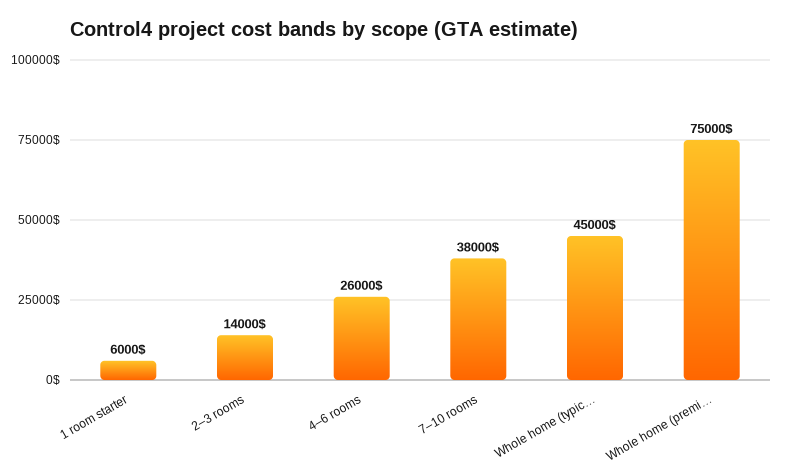
Updated for 2026. A single-room Control4 starter system in the GTA typically starts around $6,000 installed, a multi-room package runs $14,000–$38,000, and a full whole-home system commonly lands between $45,000 and $75,000. The hardware is only part of the story — programming labour and wiring are what separate quotes. Here's how the pricing really works.
What Control4 actually is — and isn't
Control4 is a professionally installed, dealer-programmed automation platform: a central controller ties together your lighting, AV, HVAC, shades, door locks, cameras and intercom into one app and one set of wall keypads. It isn't a DIY gadget ecosystem — you can't buy it off a shelf, and that's deliberate. The value is in the design and programming: scenes like "Movie Night" that dim the pot lights, drop the shades, lower the projector screen and turn the receiver on with one button. In my twenty-plus years wiring GTA homes, the projects that delight owners are the ones where the electrical rough-in and the automation design were planned together — which is exactly how we run our Control4 home automation installations.
Real Control4 project cost bands
Pricing scales with the number of rooms and systems involved. These are realistic GTA installed ranges, including hardware, wiring, programming and dealer support:
| Project scope | Typical installed cost (CAD) | What's included |
|---|---|---|
| Single-room starter (e.g. family room or home theatre) | $5,000 – $8,000 | Controller, room AV control, lighting scenes for one space |
| Multi-room package | $14,000 – $38,000 | 3–10 rooms, lighting + AV control, basic shades |
| Whole home (typical 3,000–4,000 sq ft) | $40,000 – $60,000 | Full lighting control, multi-zone AV, HVAC, shades, security integration |
| Whole home (premium / large estate) | $60,000 – $100,000+ | Everything above plus theatres, pools, gates, landscape systems |
The chart below shows how the bands step up with scope. Notice the jump between "multi-room" and "whole home" — that's where lighting control expands to every switch, keypads multiply, and programming hours grow fastest.
Home theatre and AV: where automation earns its keep
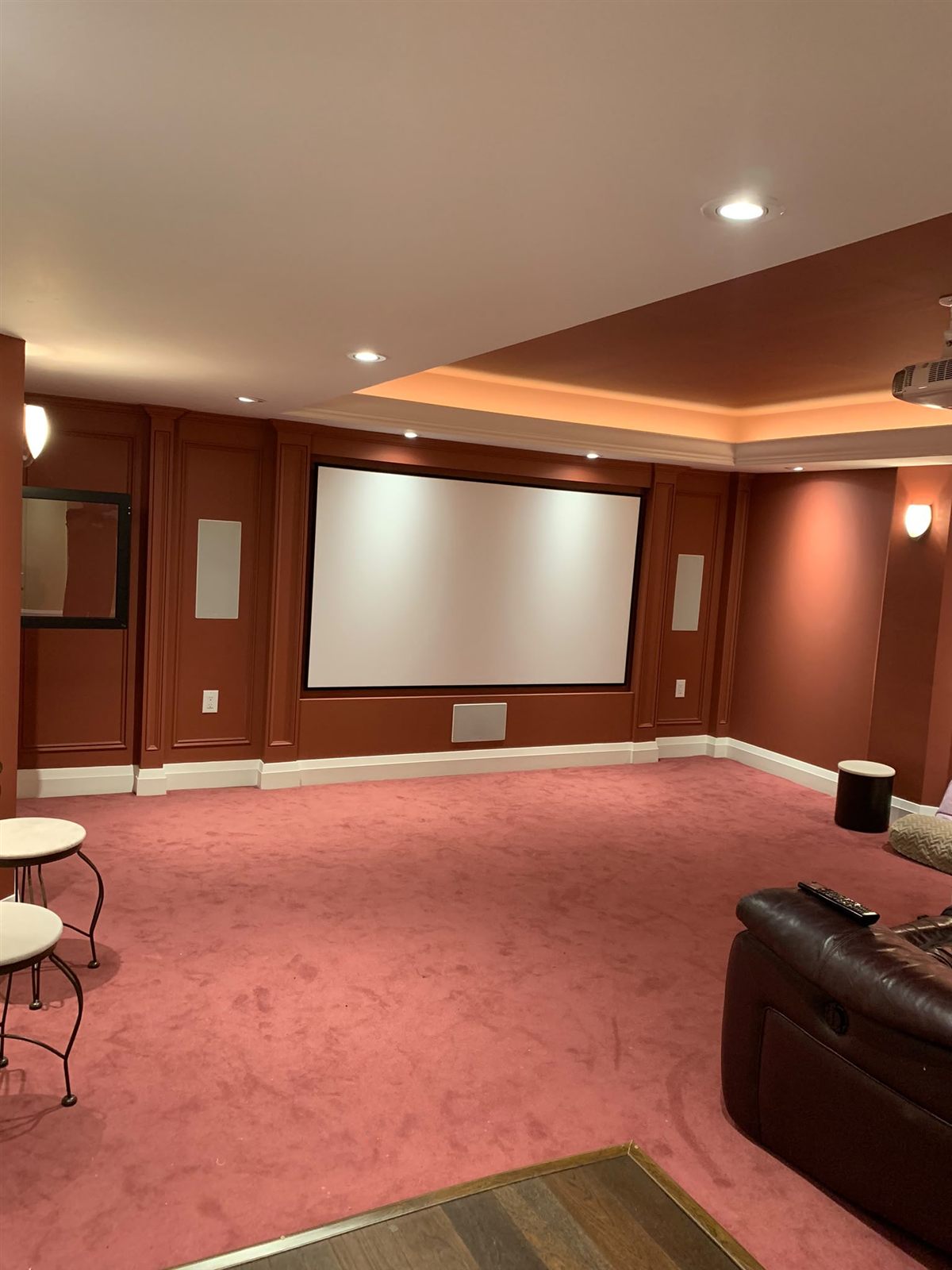
The room where Control4 pays for itself fastest is the home theatre. One remote — or one voice command — replaces the five-remotes-on-the-coffee-table problem: projector, screen, receiver, streaming and lighting all fire in sequence. That magic depends on clean low-voltage rough-in: speaker wire, HDMI conduit, network cabling and control wiring run before drywall, plus dedicated circuits installed to code with proper ESA notification. Retrofitting a finished room costs two to three times what pre-wiring costs during a build or reno. Our home theatre pre-wiring packages are designed to pair with Control4 from day one, so the theatre you build today automates tomorrow without opening walls.
What actually moves the price up or down
Two quotes with the same room count can differ by $20,000. Here's why:
- Lighting control method. Smart dimmers/switches in every location cost far less than centralized panel-based lighting, which moves switching into a rack and uses elegant keypads at the wall. Centralized systems add real cost but give the cleanest walls and the most powerful scenes.
- New build vs retrofit. Wiring during construction or a renovation is a fraction of retrofit cost. Fishing walls in a finished custom home in Vaughan or Richmond Hill is skilled, slow work.
- Programming depth. A system with thoughtful scenes, schedules and keypads takes days of dealer programming. Cheap quotes usually mean minimal programming — the system works but never feels effortless.
- Network quality. Automation rides on your Wi-Fi and wired network. Whole-home systems assume enterprise-grade access points and proper cabling; budget for it.
- Ongoing support. Dealer plans, remote monitoring and firmware updates keep the system healthy. Ask what's included for years two through five, not just year one.
Control4 vs DIY ecosystems
DIY platforms — smart bulbs, plug-in switches, a handful of app-controlled devices — make sense for a condo or a renter, and we install plenty of lighter smart lighting automation for exactly those clients. The crossover point is around four to six rooms: past that, app clutter, Wi-Fi congestion and "which app controls the kitchen?" friction eat the savings. Control4's pitch is consolidation — one app, one keypad standard, scenes that span systems — and for custom homes across Brampton and the GTA, that's worth real money. My honest advice: if you're automating one room, DIY may win; if you're wiring a whole home, do it once, do it on a real platform, and pre-wire for more than you think you'll use.
Sources
- Electrical Safety Authority — Electrical installations and permits
- Natural Resources Canada — Energy-efficient products and standby power
- Ontario Electrical Safety Code (O. Reg. 164/99)
- Canada.ca — Energy efficiency at home
Questions homeowners ask me
Is Control4 worth it compared to cheaper smart home options?
For a single room, often not — a smart TV and a couple of smart bulbs will do. For a whole home, the consolidation is the value: one reliable app, scenes across every system, keypads that guests can use without training, and dealer support when something misbehaves. If you value reliability over tinkering, it earns its price.
Can Control4 be added to an existing home?
Yes, and most of our projects are retrofits. Wireless keypads and smart dimmers cover many needs without opening walls; where walls must be opened, we combine the work with other renovations to control cost. New construction is always cheaper, so if you're building or gutting, pre-wire everything.
Does home automation require an ESA permit?
The electrical side does. Line-voltage lighting control, new circuits, panel work and low-voltage cabling in Ontario are all regulated work, and we file ESA notifications on every project. If an automation quote doesn't mention permits, that's a red flag about everything else in the quote too.
What ongoing costs should I budget?
Expect modest annual costs: controller licensing or support plans, occasional firmware updates and rare hardware failures. Budget roughly one to three percent of the install cost per year for support — it's what keeps a $40,000 system feeling new in year six.
Can I start small and expand later?
Absolutely — that's the smart path. Begin with a controller and one or two key rooms, then add zones as budget allows. The catch is rough-in: even if you automate three rooms now, pre-wire the whole home during any construction so future expansion doesn't mean re-opening finished walls.
If you're planning a custom home, a renovation or a theatre in the GTA, we design the electrical and automation together — free estimates, call 416-903-7166 and we'll scope a system that fits how you actually live.