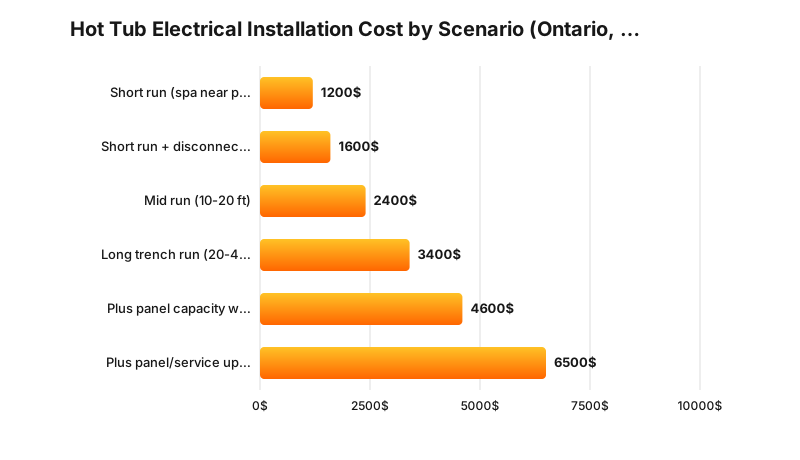
Updated for 2026. Electrical for a hot tub in Ontario typically costs $1,200 to $3,500 installed for a straightforward job near your panel, and $4,500 to $7,000 when trenching or panel capacity get involved. Every install needs GFCI protection, a disconnect, and an ESA inspection — no exceptions.
Hot tub electrical costs by scenario (2026)
Hot tub wiring isn't priced by the tub — it's priced by the run from your panel to the spa, and by what your panel can spare. Here's how the scenarios stack up in the GTA:
| Scenario | What's involved | Typical installed cost (CAD) |
|---|---|---|
| Short run | Spa pad within ~5 ft of panel; dedicated 50-60A circuit | $1,200 – $1,800 |
| Mid run | 10–20 ft through basement or along exterior, disconnect mounted | $2,000 – $3,000 |
| Long trench run | 20–40 ft trenching to backyard pad, conduit, restoration | $3,000 – $4,500 |
| Plus panel capacity | Panel has no spare capacity — tandem breakers or small panel | +$800 – $2,000 |
| Plus panel upgrade | 100A service can't carry the spa — upgrade to 200A first | +$2,500 – $4,500 |
Those numbers include the ESA notification of work and inspection — a legal requirement, not an upsell. Our hot tub and sauna electrical quotes break out trenching, coring, and panel work separately so you can see exactly what your backyard geometry costs.
The rules Ontario inspectors actually enforce
Water, electricity, and bare feet make hot tubs the most heavily regulated residential circuit we install. The Ontario Electrical Safety Code requirements that matter:
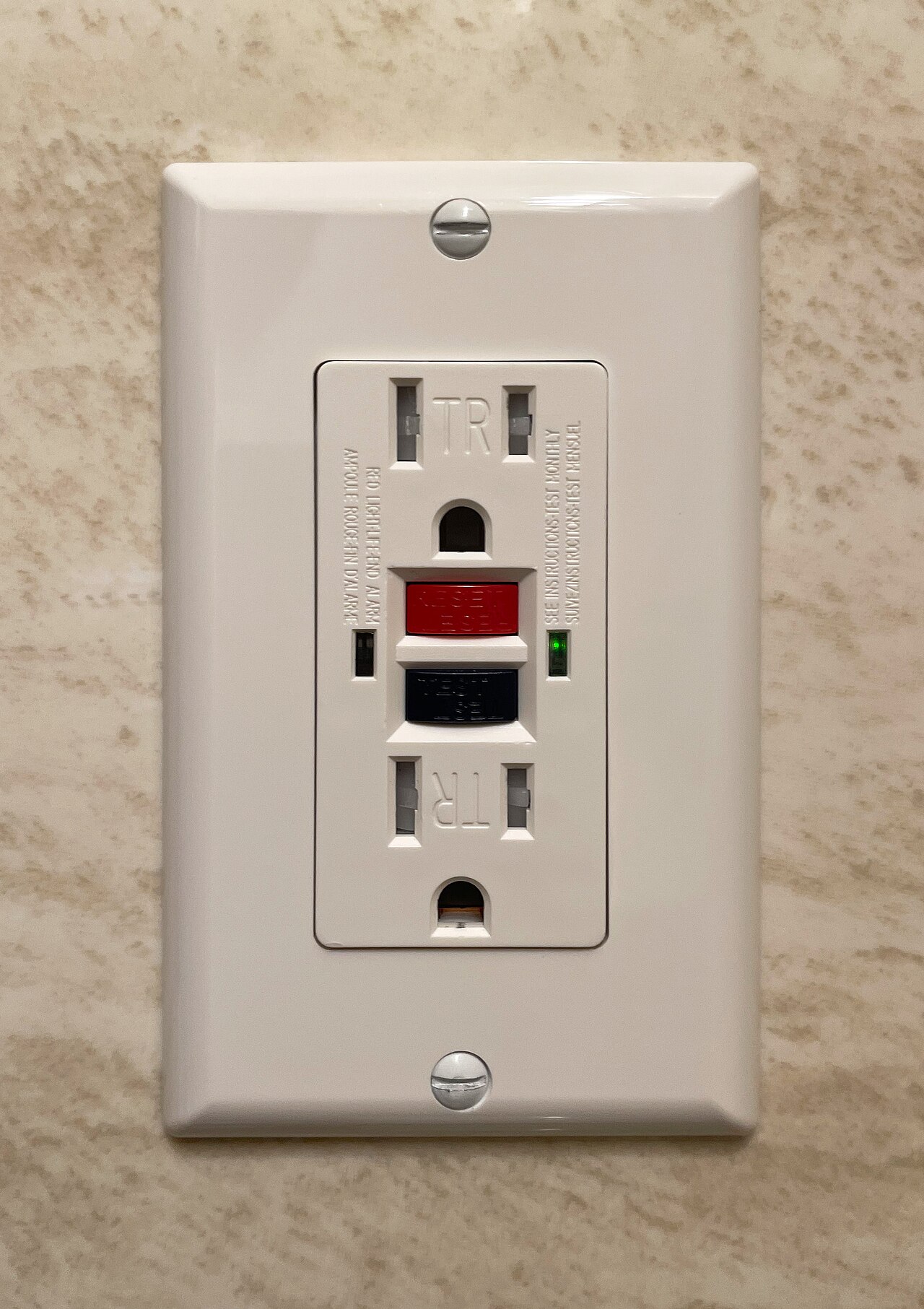
- GFCI protection is mandatory — every hot tub circuit feeds through a ground-fault circuit interrupter that cuts power within milliseconds if current leaks to water or ground. It's the rule that saves lives, and inspectors check it first.
- A visible disconnect — a switch or breaker within sight of the spa, clearly labelled, so anyone can kill power in an emergency without knowing the house.
- Bonding of everything metal — the motor, heater, metal shell, and any metal within about 1.5 metres of the water get bonded together and to ground, so no two touchable metal parts can sit at different voltages.
- Outdoor-rated everything — conduit, boxes, and fittings rated for wet locations, with proper burial depth where cable runs underground.
- Clearances from overhead lines — a tub can't sit under a service drop, which occasionally rearranges a backyard plan in Caledon and rural lots more than homeowners expect.
What the installation includes
A proper hot tub electrical package: a dedicated circuit sized to the tub's load (most 220V spas draw 40–60 amps depending on heater and pump count), the run itself in proper cable or conduit, a weatherproof disconnect at the spa, GFCI protection, bonding of the spa's metal parts, and the ESA inspection. Where the tub sits away from the house, we trench in conduit at code depth and restore the surface properly — not the shallow, bare-buried cable jobs that fail inspection and rot within a decade.
The most common pre-install conversation is about the panel. A 60A hot tub circuit on a panel already feeding central air, a dryer, and an EV charger often needs a load calculation before anything else. When capacity genuinely doesn't exist, a panel or service upgrade done first is always cheaper than doing the tub twice.
Plug-and-play vs 220V hardwired tubs
You've seen the "just plug it in" 110V spas. Honest take: they're legitimate for small, lightly-used tubs — a 15A 110V circuit can run a small spa, slowly. But recovery times stretch (reheating after a soak can take a day), jets and heater often can't run together, and in a Canadian winter most 110V tubs spend all their power just holding temperature. Families who actually use a tub year-round end up wanting the 220V install they skipped. If you're buying a tub this year, run the 50 or 60A circuit during delivery — the pad is open, the trench is fresh, and the marginal cost is lowest.
Common mistakes that cost homeowners money
- Budgeting the electrical last. The tub dealer quotes the shell; the circuit, trench, and panel work arrive as a surprise. Get the electrical quote before the tub lands on the pad.
- Assuming the existing deck outlet is enough. A deck receptacle circuit is 15A and shared — never a hot tub supply.
- Letting the delivery crew "handle the hookup." In Ontario, hot tub connections are electrical work requiring a licensed electrician and ESA inspection. Unpermitted hookups get flagged at resale and can void insurance claims.
- Forgetting winter loads. A tub holding 37°C through a -20°C week is working hard — undersized circuits and tired breakers show their weakness in January, not July.
Sources
- Electrical Safety Authority (ESA) — permits and inspection requirements for hot tub electrical in Ontario.
- Ontario Electrical Safety Code (O. Reg. 164/99) — GFCI, bonding, and disconnect rules for spas.
- ESA homeowner electrical safety guides — pool and hot tub safety guidance.
Frequently asked questions
Do I need a permit to install a hot tub in Ontario?
Yes — the electrical connection requires an ESA notification of work and inspection, and the installer must be a licensed electrical contractor. The certificate goes in your paperwork file and shows up favourably at resale and with your insurer.
What size breaker does a hot tub need?
Most 220V spas need a dedicated 50A or 60A circuit, sized from the tub's nameplate load — heater and pumps together. The dealer's spec sheet tells us the number; we verify it against the panel before quoting anything.
How far can a hot tub be from the electrical panel?
Distance isn't limited, cost is. Each metre of run adds cable, conduit, and labour; beyond roughly 25–30 ft across a yard, trenching usually beats any interior route. We've run tubs 60+ metres — the owners just knew the budget going in.
Can I use an extension cord for my hot tub?
Never for a 220V hardwired spa, and only within the strict limits of the manufacturer's 110V cord on plug-and-play models. Extension cords are among the leading causes of outdoor electrical fires — a soaked, overheated cord beside a tub is exactly the scenario GFCI rules exist to prevent.
Does a hot tub add much to my hydro bill?
Expect $20 – $50 a month in the swimming season and $40 – $80 through a cold winter for a well-insulated 220V unit — heater run time, not the electrical connection, drives the bill. Good covers, windbreaks, and keeping the set temperature steady matter more than any electrical trick.
Hot tubs are one of our favourite installs — done right in a day, inspected, and safe for years of winter soaks. We wire spas across Brampton and the GTA. Call 416-903-7166 or request a free online quote — ideally before the delivery truck arrives.